
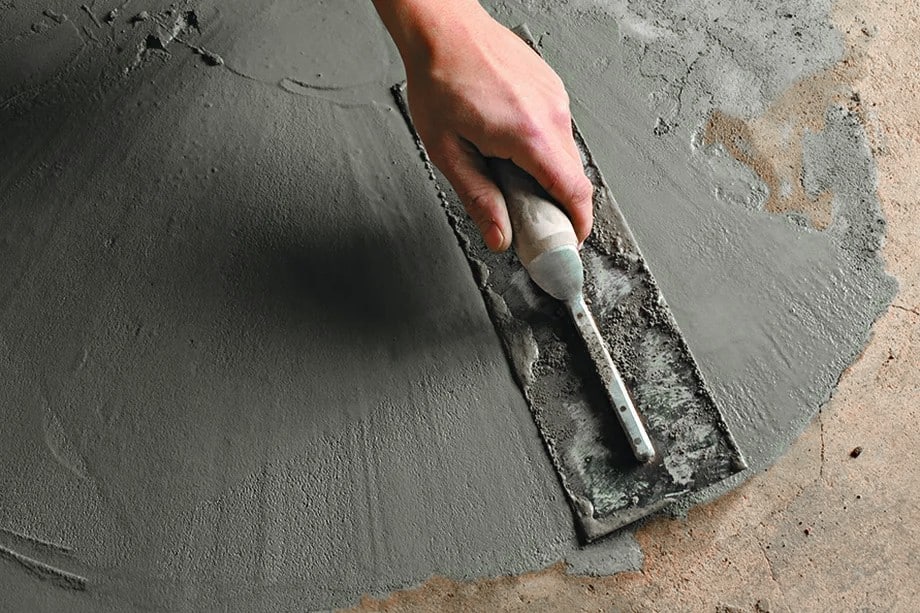
A floor that looks flat can still hide uneven areas, and those imperfections can ruin a new flooring installation before it begins. Whether you’re preparing a subfloor for tile, vinyl plank, epoxy, or laminate, one question often comes up: should you patch the low spots or pour self-leveling cement across the entire area?
Although both methods use cement-based products, they address different problems and require different preparation. Choosing the wrong approach, or ignoring surface preparation, can lead to flooring failures, wasted materials, and costly repairs down the road.
Floor Patching: Fixing Small, Specific Problems
Floor patching compound is designed for targeted repairs. It’s a thicker, faster-setting cement-based product used to fill:
- Small holes, gouges, or chips in concrete
- Cracks and control joints before flooring installation
- Spalled or pitted areas from old adhesive removal
- Minor low spots that don’t affect the whole room
Patching compound is applied by hand with a trowel or putty knife, feathered at the edges, and typically dries hard enough to sand or grind flat within a couple of hours. It’s the right tool when the vast majority of your floor is already flat and sound, and you only need to address isolated trouble spots.
Self-Leveling Cement: Fixing The Whole Floor At Once
Also known as self-leveling underlayment, is a different animal entirely. It’s a pourable, free-flowing cement mixture that spreads across a large area and settles into a smooth, level plane using gravity and its own flow characteristics. It’s the right choice when:
- The subfloor has multiple low spots or uneven areas across a large section
- You’re transitioning between rooms with different floor heights
- You’re covering a rough, patched, or previously tiled surface
- You need a smooth, consistent substrate for glue-down vinyl, engineered wood, or large-format tile
Because it is poured rather than troweled, it typically requires a primer coat first to control absorption and prevent the mixture from drying too fast or bonding poorly, along with edge dams to contain it in doorways or open transitions.
Patching vs. Self-Leveling: The Quick Comparison
| Factor | Floor Patching | Self-Leveling Cement |
| Best for | Small, isolated repairs | Large or whole-room unevenness |
| Application | Trowel or putty knife | Poured and self-spreads |
| Set time | Fast, often workable same day | Varies, usually walkable within hours |
| Coverage | Spot repairs | Full room or large sections |
In many real-world projects, both methods are used together. Deep holes or cracks get patched first, and then a self-leveling pour evens out the rest of the floor for a consistent surface.
Why Moisture Control Matters Just As Much As Leveling?
A perfectly flat floor is only half the equation. If moisture is migrating up through the concrete slab, it can soften adhesives, warp vinyl and wood flooring, and cause self-leveling cement itself to fail from underneath.
This is where a moisture barrier for concrete floor applications becomes essential, especially in basements, slab-on-grade homes, and older buildings where vapor testing hasn’t been done.
The best moisture barrier for concrete floor projects is one that’s flexible enough to move with minor substrate stress while still forming a continuous seal against rising vapor. This is exactly the gap Perfect Membrane is built to fill.
It works as a flexible, liquid-applied waterproofing and coatings-primer system in one, forming a seal directly over concrete before self-leveling cement, tile, or coatings go down on top. Because it’s compatible with most epoxies, paints, and modified cements, it can be worked directly into a patch-and-level workflow without adding an extra incompatible layer.
When Old Flooring Adds Another Layer: Asbestos And Encapsulation
Patching and leveling projects often start with tearing up old flooring, and that’s where a completely different concern can show up: asbestos-containing mastic or tile adhesive left behind on the slab. Grinding or scraping that material to prep for patching or self-leveling is exactly what OSHA and EPA guidelines warn against, since it risks releasing airborne fibers.
Instead of removal, an encapsulation paint asbestos solution seals the old adhesive in place so it’s safe to patch and level directly over it. PerfectPrimer is formulated specifically for this purpose, encapsulating asbestos mastic and adhesive residue to EPA guideline standards without grinding or chemical strippers. Once cured, it creates a stable, bondable surface that patching compound, self-leveling, or Perfect Membrane can be applied over with confidence.
A Practical Prep Sequence
For a floor with old adhesive, cracks, and unevenness, a straightforward sequence looks like this:
- Clean the slab with a non-toxic degreasing cleaner to remove dust and residue.
- Encapsulate any suspect old mastic with PerfectPrimer® Encapsulant before disturbing it further.
- Patch isolated holes, cracks, or gouges with a cement-based patching compound.
- Apply Perfect Membrane where moisture protection is needed.
- Pour the levelling cement over the full area for a smooth, consistent surface.
- Confirm full cure times before installing the finished flooring.
Check Out The Products Now!!
Getting a floor level, moisture-protected, and safely prepped isn’t about picking one product and hoping for the best. It’s about using the right combination for the surface you’re actually working with.
Explore our full lineup of encapsulating primers, moisture barriers, and floor prep systems at PerfectPrimer to build the right prep sequence for your next project.
Floor Patching And Self-Leveling Cement FAQs
1. Can I use self-leveling cement instead of patching compound?
Not ideally for small repairs. Self-leveling cement is designed to flow and settle across large areas, so using it for a single small hole often wastes material and can be harder to control than a simple patch.
2. Do I need a moisture barrier before pouring self-leveling cement?
In most cases, yes, especially over concrete slabs with no known vapor barrier underneath. A flexible product like Perfect Membrane helps prevent trapped moisture from damaging the leveling layer and the finished floor above it.
3. Is it safe to pour self-leveling cement over old asbestos mastic?
Only after the mastic has been properly encapsulated. Disturbing asbestos-containing adhesive during prep work violates OSHA and EPA guidance. PerfectPrimer® Encapsulant is designed to seal it in place first, creating a safe, bondable base for patching and leveling.
4. How long does self-leveling cement need to cure before flooring installation?
Cure times vary by product thickness and site conditions, but most self-leveling underlayments are walkable within a few hours and ready for flooring within 24 to 48 hours. Always confirm with manufacturer specifications for your specific product.
5. What’s the best moisture barrier for concrete floor projects with existing cracks?
A flexible, liquid-applied membrane is generally the better choice over rigid sheet products, since it can move with minor substrate cracking while maintaining its seal. Perfect Membrane is formulated for exactly this kind of flexible, crack-tolerant waterproofing.


